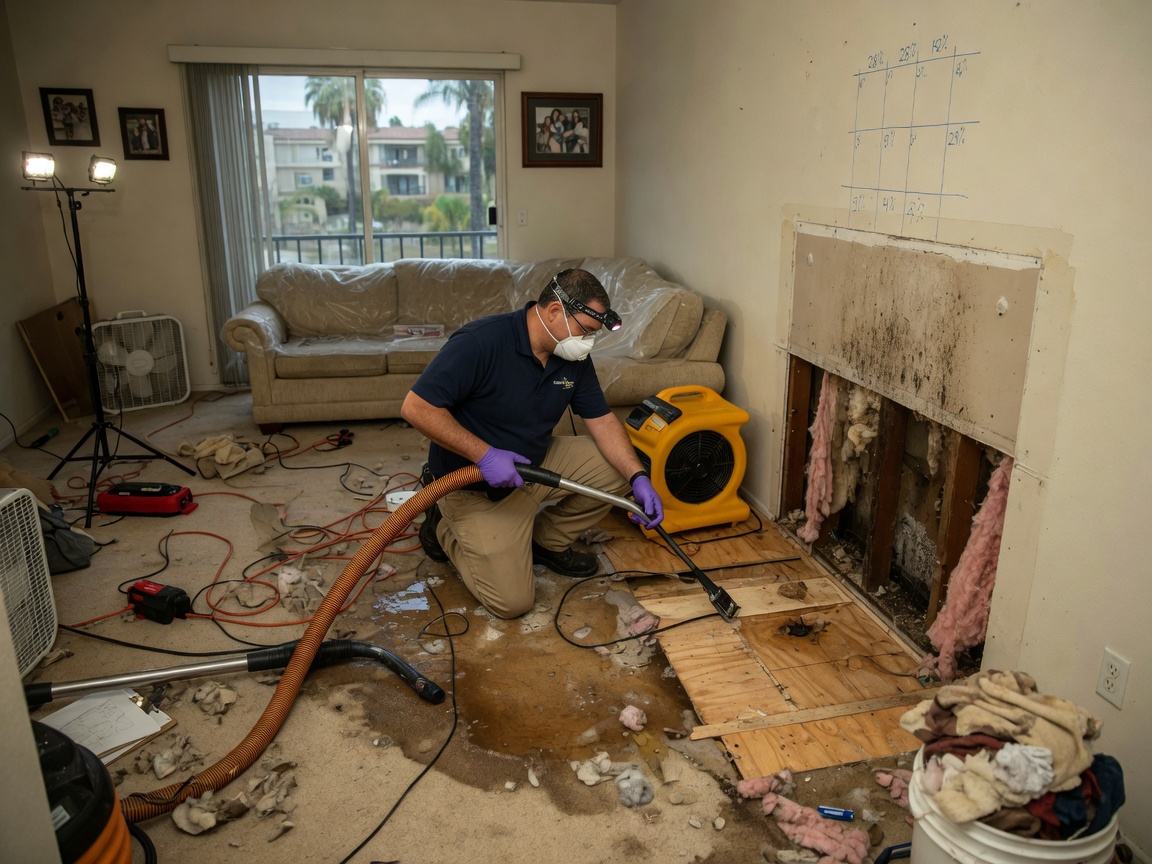
North Hills sits in a hot-summer Mediterranean climate where long dry periods are interrupted by sudden winter rains that overwhelm older roof drains and yard grading. Many homes in North Hills East and North Hills West were built between the 1950s and 1970s with stucco exteriors and slab-on-grade foundations that direct water under walls when soil swells. Prestige Environmental responds from our Nordhoff Street shop to stop intrusion before it reaches subfloor plywood or reaches the Sepulveda Basin flood plain.
After extraction we use moisture meters on concrete slabs and behind baseboards because trapped water in Los Angeles County soil can wick upward for weeks. We remove baseboards, drill weep holes in drywall, and place air movers in a grid pattern so air reaches every stud bay rather than just blowing across the surface. Homeowners in Panorama City and Granada Hills often discover that their 1960s galvanized pipes have pinhole leaks that only appear after a neighbor’s irrigation line bursts.
We document every step with photos and meter readings so insurance adjusters see the exact scope without multiple site visits. Work stops only after the structure reads within two percent of outdoor ambient moisture; anything higher risks hidden mold behind cabinets or under vinyl flooring common in these neighborhoods.
Technician insight
In North Hills the thing that catches most people out with water damage restoration is the way dry-summer soil cracks then seals around slab edges; a small irrigation leak can travel ten feet under the foundation before anyone notices. Homeowners often stop at surface drying and miss the moisture that stays trapped under vinyl or carpet pad.
Hidden Slab Leak After Irrigation Failure
A homeowner in North Hills West noticed soft flooring near the laundry room after a neighbor’s sprinkler line broke. We mapped elevated moisture readings across the slab, extracted water that had traveled under the wall, and ran drying equipment for four days until the concrete returned to normal readings.
Water Damage Restoration Services We Offer
✓Emergency Water Extraction
Rapid removal of standing water from kitchens, bathrooms and garages using truck-mounted pumps sized for North Hills slab homes.
✓Structural Drying and Dehumidification
Placement of commercial air movers and dehumidifiers to pull moisture from stucco walls and concrete slabs before mold sets in.
✓Subfloor and Slab Moisture Mapping
Meter readings across plywood and slab sections to locate hidden water that travels under partitions in 1950s-1970s North Hills construction.
✓Drywall and Insulation Removal
Targeted removal of saturated drywall and insulation up to the moisture line so only damaged material is replaced.
✓Carpet and Pad Extraction
Hot-water extraction and pad removal for wall-to-wall carpet found in many North Hills West ranch homes.
Water Damage Restoration Cost in North Hills, CA
| Service | Typical Range | What Affects It |
|---|---|---|
| Initial Assessment And Extraction | $250–$650 | Varies with gallons removed and number of rooms |
| Daily Drying Equipment | $150–$350 | Per day; longer runs needed after heavy rain near Sepulveda Basin |
| Subfloor Moisture Mapping | $200–$400 | Required on slab homes in North Hills East |
Ranges are typical for North Hills, CA and confirmed with an exact written quote before any work starts.
How it works
- 1
Arrival And Safety Shutoff
Technician arrives, locates the source, and shuts off water or power if needed before any extraction begins.
- 2
Water Removal
Standing water is pumped or vacuumed out, then moisture meters map remaining damp areas in slabs and walls.
- 3
Drying Setup
Air movers and dehumidifiers are placed and adjusted daily until readings match outdoor conditions.
- 4
Final Verification
Photos and meter logs are provided; any remaining repairs such as drywall replacement are scheduled.
Pricing
Pricing depends on water volume, affected square footage, and whether slab or subfloor drying is required.